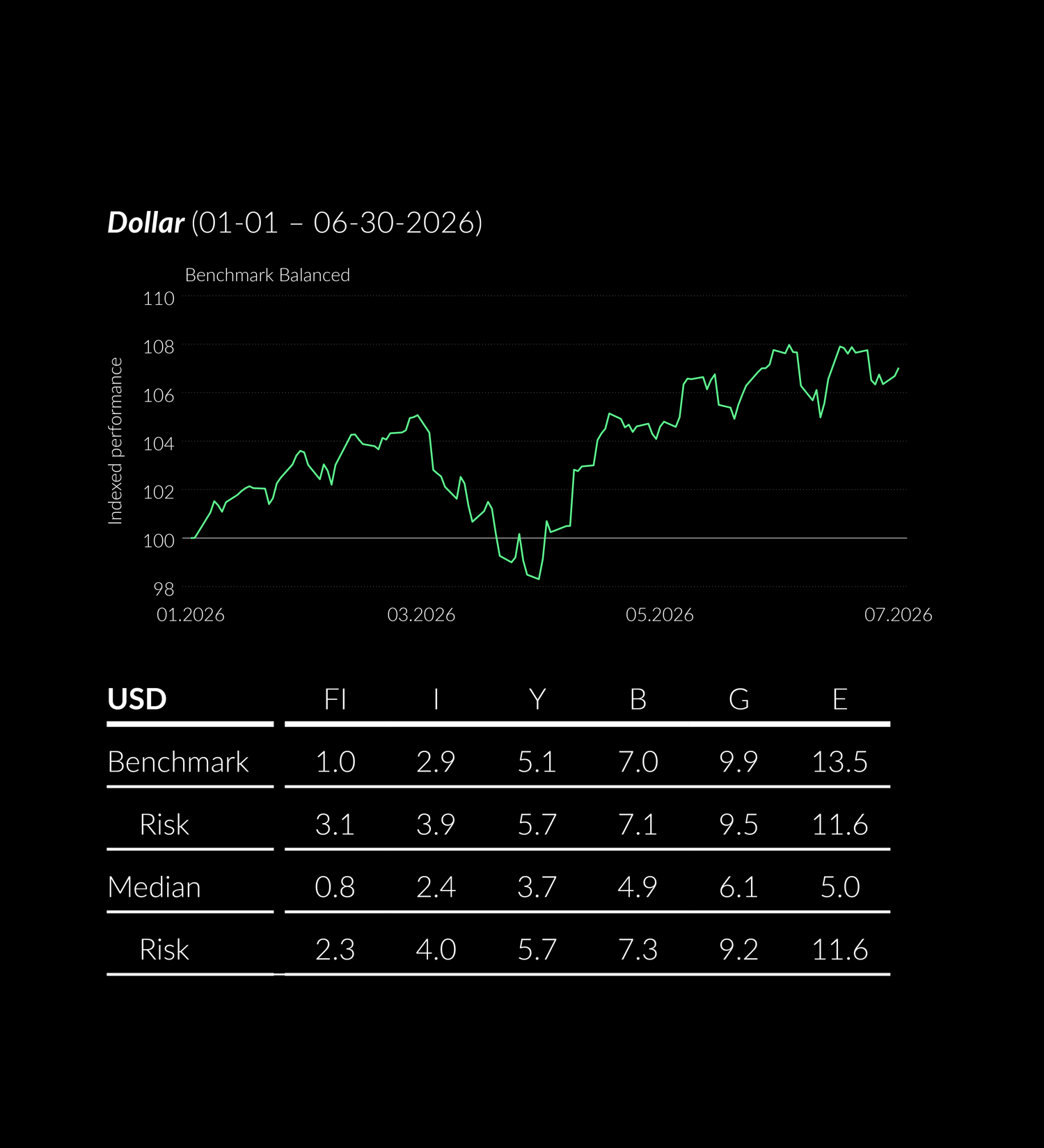
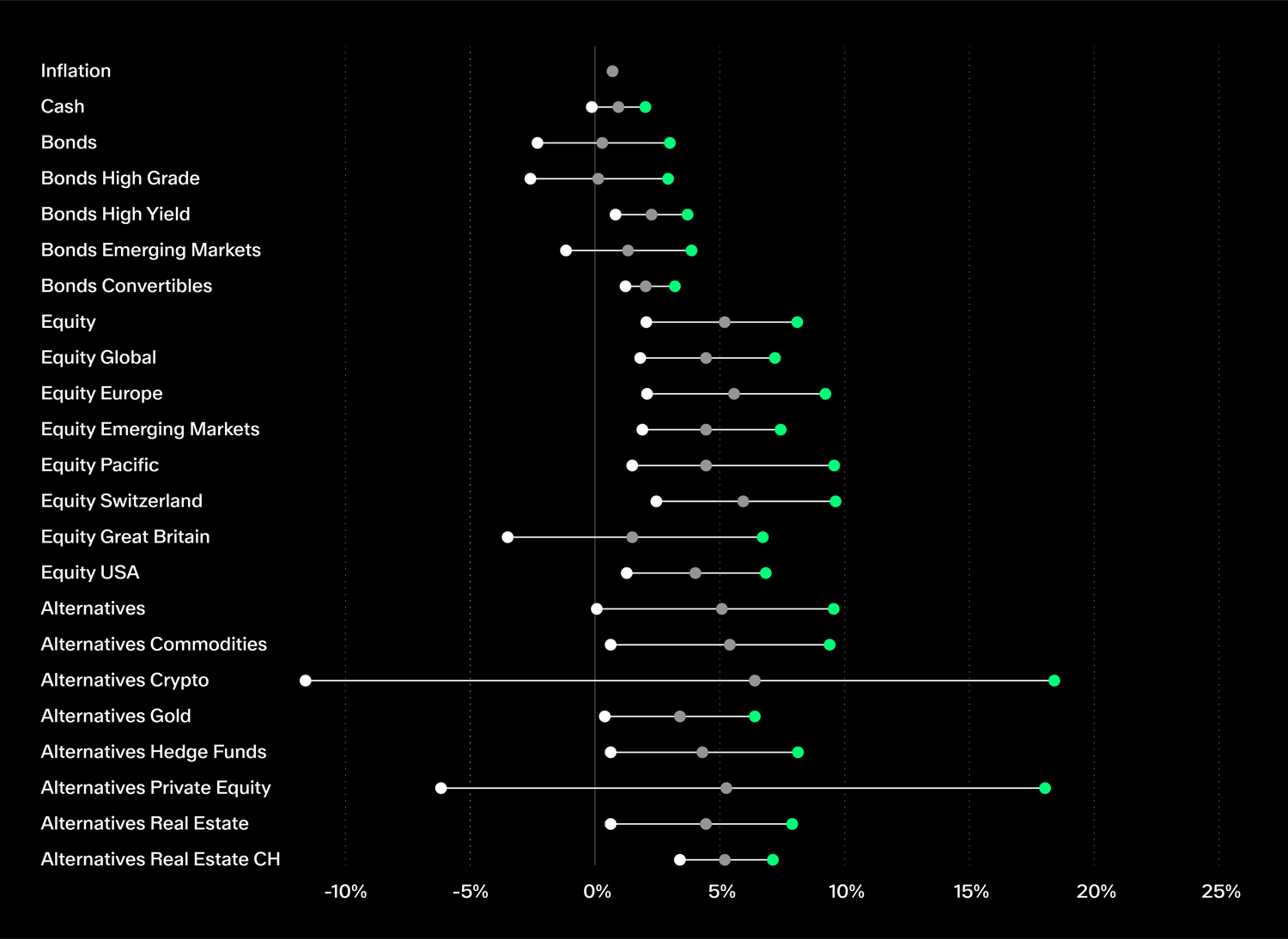
How it works: A Wealth Officer from Zwei Wealth will work with you to create an asset structure tailored to your goals and develop a suitable investment strategy. We call this «Plan.». Our advice is based on analyses carried out by our experts.
Here you will find our latest market assessments, which also form the basis for your own investment strategy.
Patrick Müller talks to Klaus W. Wellershoff about the general economic situation.
Market sentiment could hardly be more divergent. While equity markets recorded another exceptionally strong month, valuations for gold, commodities and Bitcoin fell sharply. What is behind this? The development reflects the general expectation of an economic upswing with inflation kept under control. The economic indicators, however, do not yet confirm this, although they have improved slightly overall.
For your investment committee
The Wealth Office Investment Committee analyzes and discusses the most important events and developments on a quarterly basis (9 April 2026).
Chartbook and current market assessment
Strategic Considerations
What questions should be clarified before investment decisions are made? How are goals clearly defined, roles determined and decision-making processes structured? Zwei Wealth's strategic questions shed light on key fundamental issues relating to wealth management, governance and long-term orientation, providing guidance for well-founded decisions.
Economic growth: Solid growth and hopes for positive effects from a peace agreement
Despite the ongoing Iran conflict, the global economy has so far shown only limited signs of being affected. Sentiment in the services sector has improved slightly. Consumer sentiment has also recently benefited somewhat from hopes of geopolitical peace signals.
However, whether this cautiously positive development proves sustainable remains open. As no peace agreement has yet been reached and the Strait of Hormuz remains closed, the current signs of hope should be interpreted with caution.
Inflation: Clear increase, but fortunately not yet in the core rate
Inflation in industrialised economies remains on an upward trend, driven primarily by the conflict-related closure of the Strait of Hormuz and the associated rise in energy prices. This is particularly evident in the US, where consumer prices rose to 4.2 percent, and in the eurozone, where they increased to 3.2 percent.
However, inflationary pressure has still only passed through to core inflation to a limited extent. Since no solution to the conflict has yet been reached, it remains difficult to assess what consequences it will have for global inflation.
Monetary policy: Central banks remain confident
The central banks’ monetary policy meetings in June were shaped by inflationary pressure triggered by the Iran conflict, as well as the generally tense geopolitical environment. Both the ECB and the BoJ therefore raised their key interest rates to counter rising inflation.
The US Federal Reserve, by contrast, left its key interest rate unchanged. However, Kevin Warsh announced a strategic shift in his speech: the new policy direction focuses on ending forward guidance and placing greater emphasis on the 2 percent inflation target. The Swiss National Bank also left its key interest rate unchanged at 0 percent. Inflation remains within a moderate range, meaning there is currently no immediate need for action.
Overall, the Iran conflict has further intensified the monetary policy challenges faced by central banks. In addition to renewed inflationary pressure, further economic slowdowns are looming, the scale of which remains difficult to assess at this stage.