
As every year, Zwei Wealth has analyzed the performance of banks and asset managers. The broad database of several hundred real portfolios allows a differentiated and independent view of which results can be considered in line with the market in 2025 - and where there are significant deviations.
The comparison once again shows a clear spread between good and weaker results. It remains challenging for investors to assess the quality of an asset management mandate solely on the basis of marketing statements or relative benchmarks. The comparability of net returns remains limited, particularly in the interplay between costs, risk profile and actual implementation.
Although the financial markets developed positively overall in 2025, this also increased the demands on the implementation of active asset management. Accordingly, differences in the quality of mandate management became more apparent.
"Our analysis shows once again that the performance of asset managers can be clearly differentiated. Despite positive markets overall, comparable mandates achieved very different results."
Patrick Müller
CEO Zwei Wealth
Volatile stock markets
2025 was another strong but also very volatile year for the equity markets. Almost all major indices - including the US, European, Swiss and Asian markets - achieved returns of 15% or more in local currencies. However, the pronounced upward and downward movements over the course of the year led to considerable differences in implementation by asset managers. They were presented with opportunities for outperformance as well as risks of mistakes and thus underperformance.
In the Swiss franc equity portfolios analyzed by Zwei Wealth, there was a difference of over 40 percentage points between the best and the weakest mandate. Even a CHF equity portfolio with a return of more than 8.3 percent was among the top half of all the mandates analyzed.
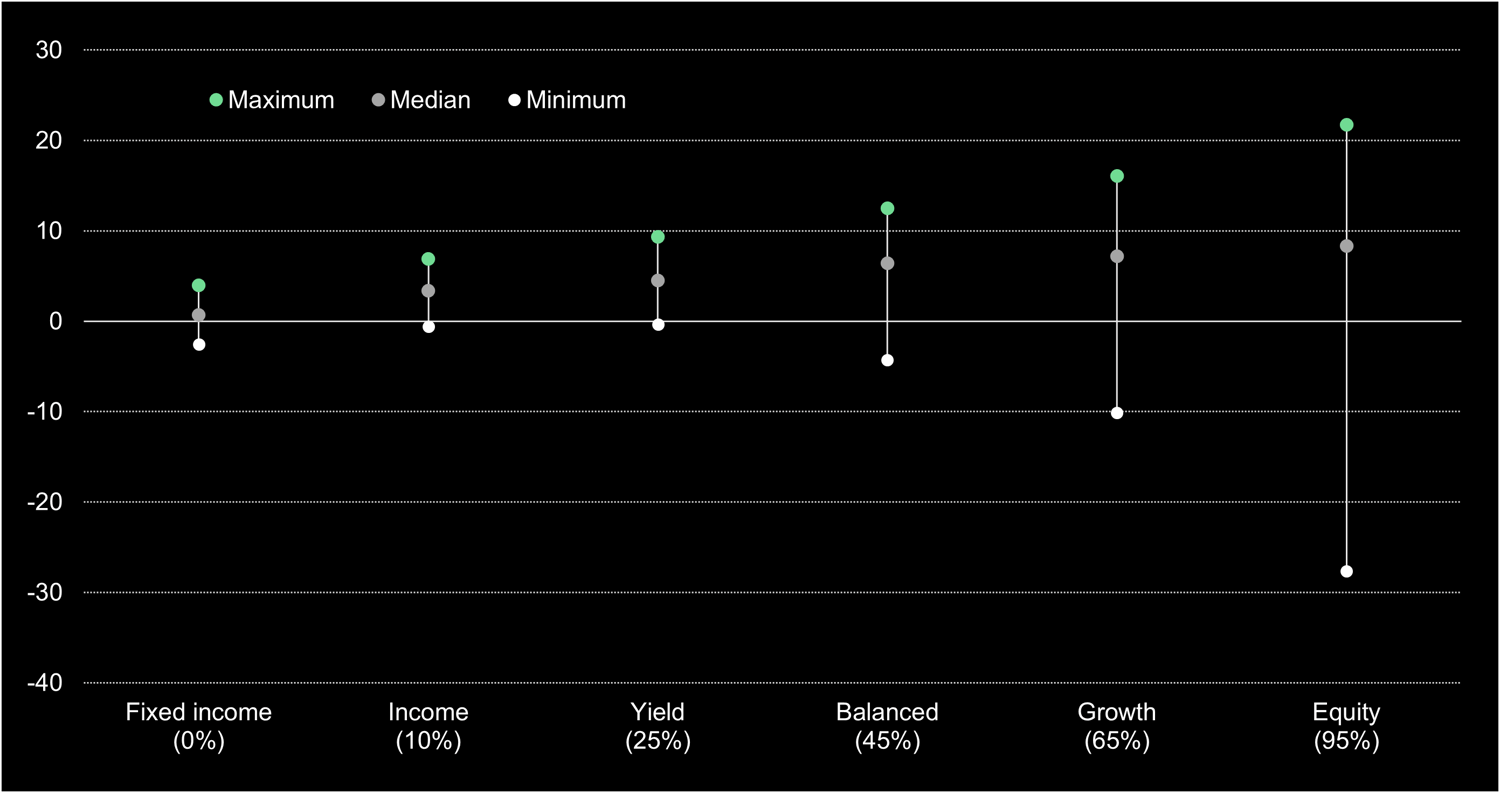
Yield comparison of portfolios in Swiss francs
High diversification across all risk profiles
The pronounced differences in performance in 2025 were not only evident in pure equity mandates, but across all risk profiles. This was particularly evident in the traditional balanced risk profile with an equity allocation of around 45%. The returns achieved here varied significantly: from minus 4% to plus 12%. In this environment, a result above the median value of 6.4% can be classified as in line with the market.
There was also a considerable spread in the very conservative bond segment without an equity component: The results ranged between minus 2 and plus 4 percent, with a median yield of 0.7 percent.
The differences between good and weaker managers were also clearly evident across different currencies. The dispersion of returns was pronounced in both euro and US dollar portfolios, although it increased further in these portfolios as the proportion of equities rose.
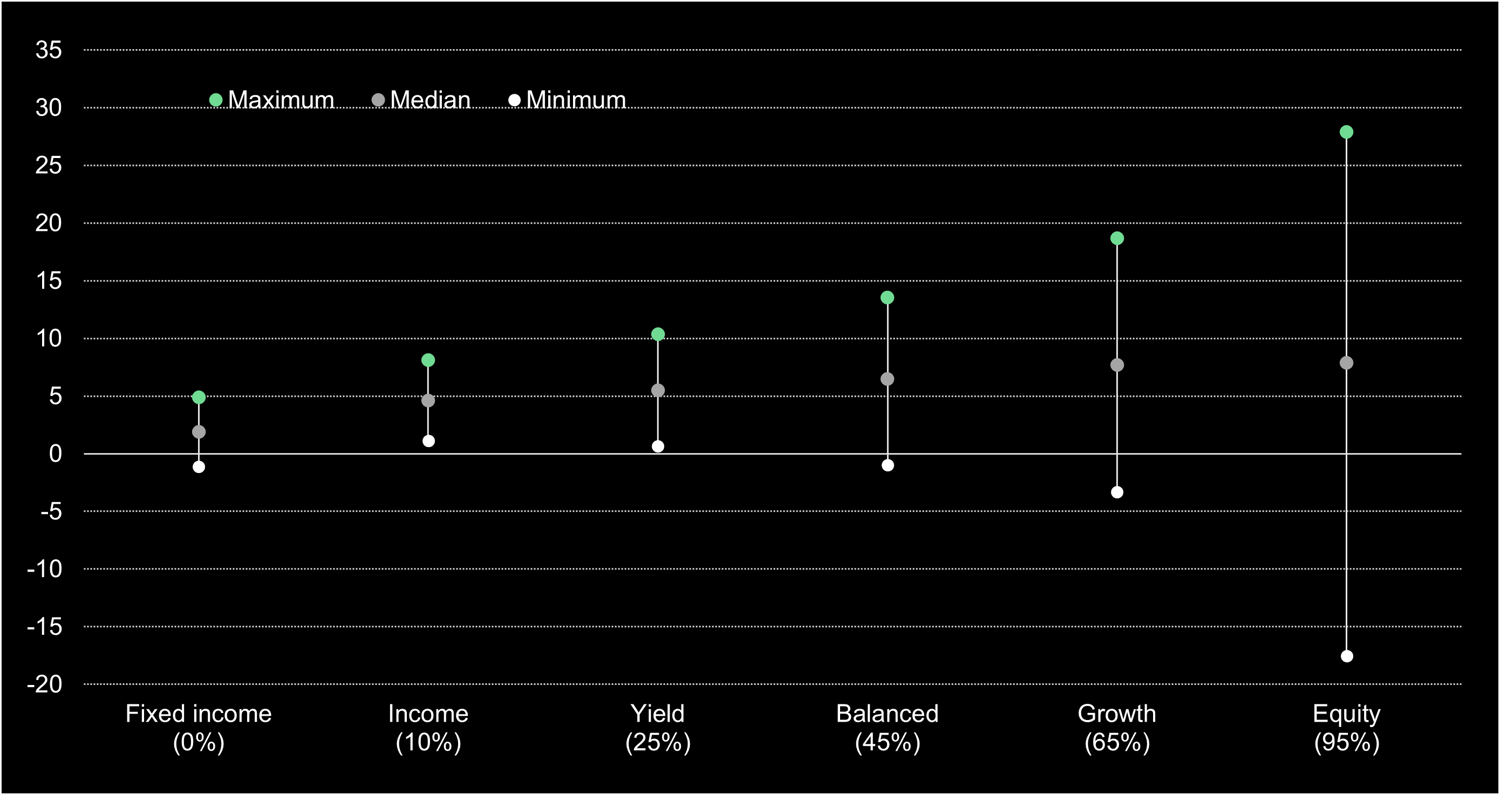
Yield comparison of portfolios in euros
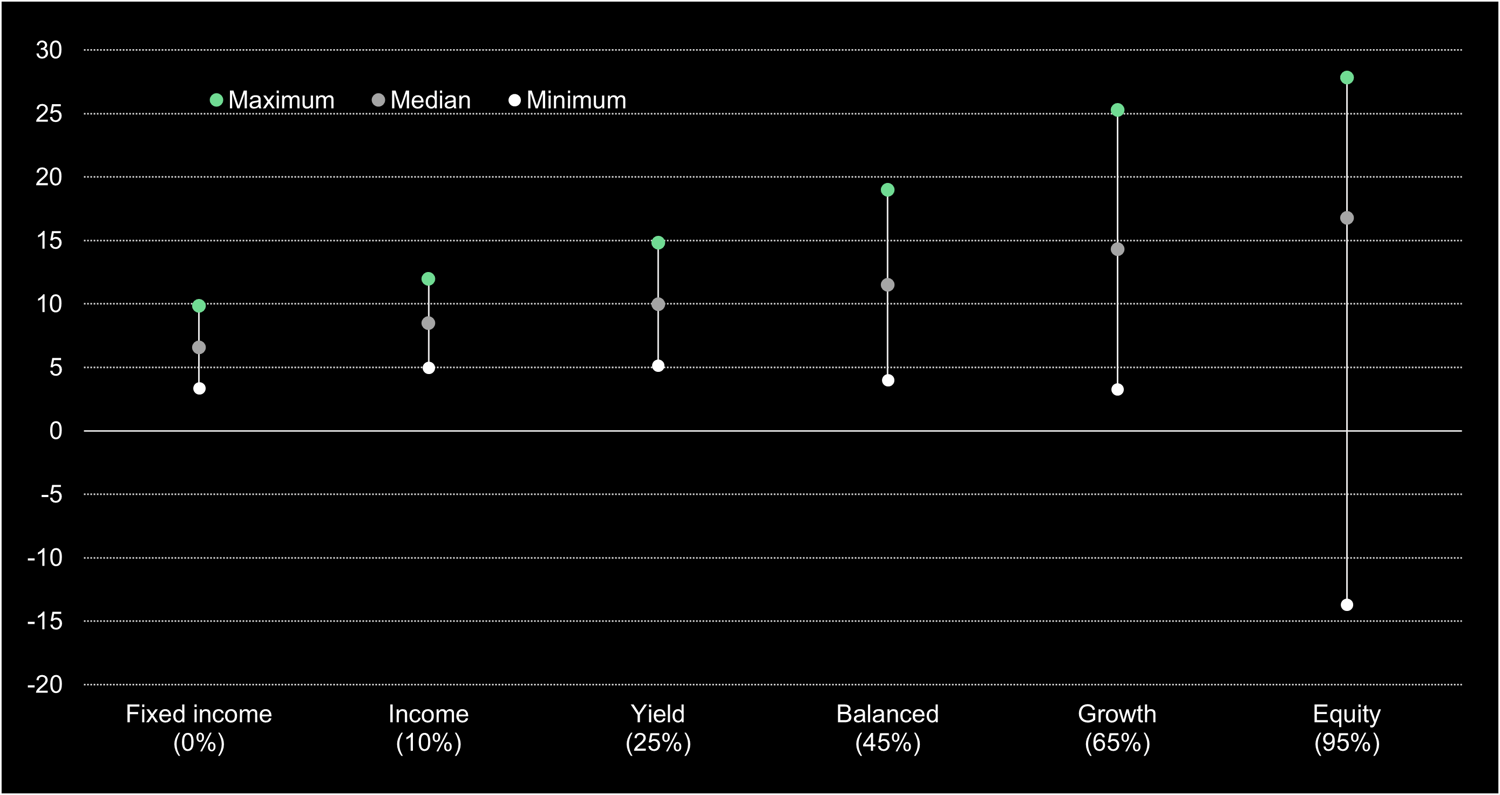
Yield comparison of portfolios in US dollars
The USD effect was significant
A key factor influencing the returns achieved in 2025 was the development of currencies, particularly the US dollar. While the euro only lost around 1% against the Swiss franc, the depreciation of the US dollar had a much greater impact. Over the course of the year, the USD depreciated by over 12% against the Swiss franc.
This development had a noticeable impact on globally oriented portfolios. At the same time, US dollar portfolios achieved robust results in some cases. In the bond segment, median returns were 6.6%, while equity mandates achieved median returns of up to 17%.
Style makes the difference
The year 2025 clearly showed that different investment styles led to very different results. Strategies with a focus on dividends/high income performed well overall and recorded increased inflows of client funds over the course of the year, boosted by the falling interest rate environment.
Growth strategies remained in the lead, particularly in the USA and in portfolios with a high US weighting. This development was once again driven by large technology and AI companies, which dominated the market. The majority of managers with a momentum approach also achieved results above the broad benchmarks.
Value strategies proved resilient, but did not outperform overall - with possible exceptions in selected European portfolios. Quality-oriented strategies, on the other hand, fell short of expectations in many cases over the course of the year. US-heavy quality portfolios in particular even posted negative returns in some cases.
Passive portfolios ahead of active managers
Passive investment strategies outperformed actively managed portfolios on average last year. This finding confirms the results of previous analyses by Zwei Wealth. However, the classification is crucial: the average conceals considerable differences within the group of active asset managers.
While many active managers lagged behind the corresponding passive benchmark strategies, individual active asset managers did an outstanding job and clearly outperformed. The challenge was therefore once again to identify these providers and to consistently trust their investment strategy.
"The results show that blanket judgments are of little help. Passive strategies are ahead on average, while at the same time there are active managers who clearly outperform the market. The decisive factor is not the approach, but the quality of implementation."
Patrick Müller
CEO Zwei Wealth
The analysis also shows that active management works particularly well for fixed-income portfolios and in markets with a high proportion of small and mid-cap companies. One example of this is the Swiss market.
A comparison of accompanied mandates
The analysis shows that portfolios that were managed as part of a wealth office were also above the general median values of the mandates analyzed on average in 2025.
Zwei Wealth's comparison of returns in 2025 provides you with a structured and comparable evaluation of the returns of leading providers. Order the latest edition now.
-Karabiner.jpg?width=1200&name=2025-03-11%2022-37-55%20(B,R1,S5)-Karabiner.jpg)